
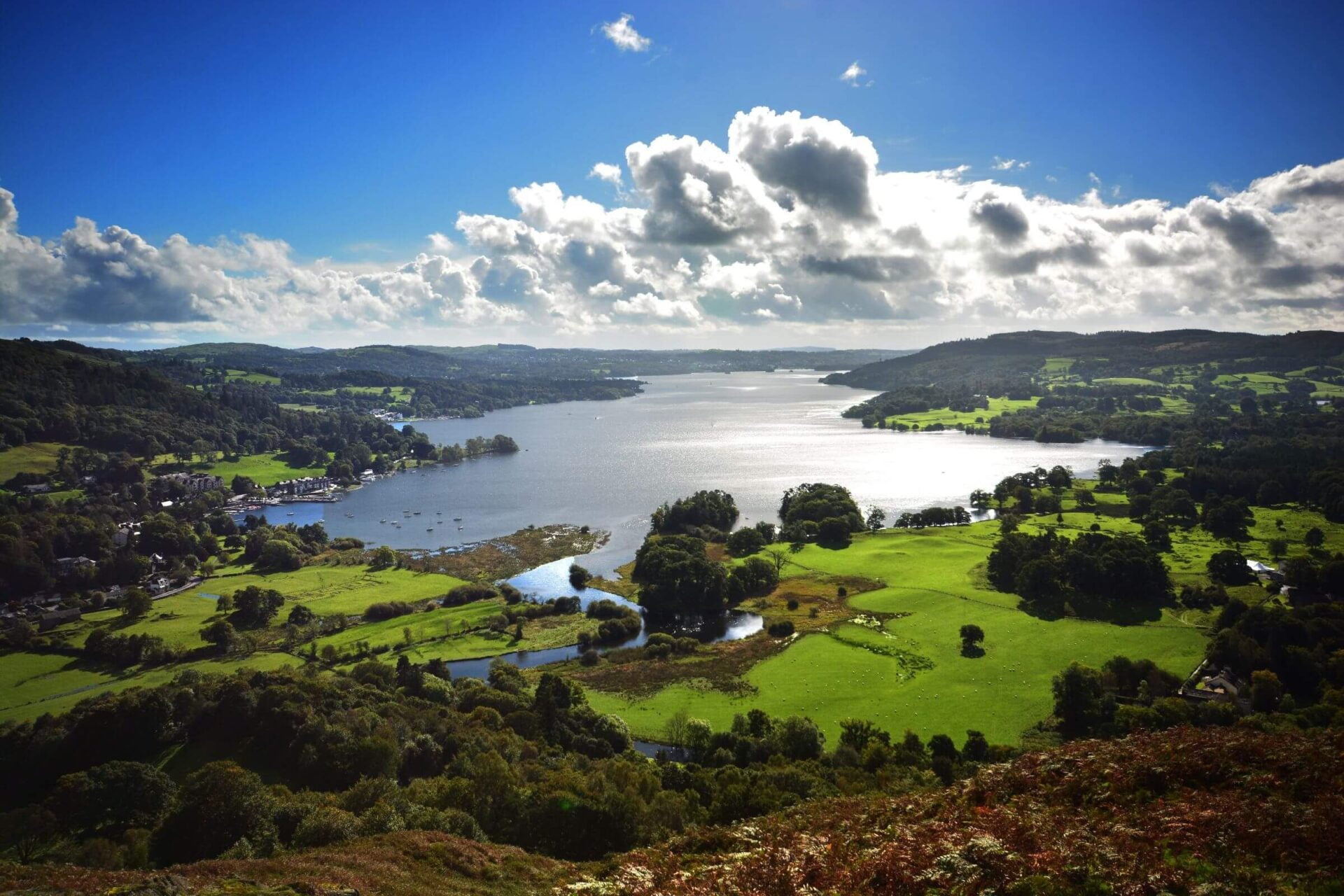
Understanding Human and Climate Pressures on Lake Windermere’s Health
Customer: UK Space Agency
Map Impact worked with stakeholders including Save Windermere, supported by funding from the UK Space Agency, to explore how geospatial intelligence could improve understanding of the environmental challenges facing Lake Windermere. The project combined satellite imagery, climate data and anonymised human movement information to deliver new evidence about water quality, algal blooms and wider ecological pressures affecting England’s largest freshwater lake. The resulting analysis provided stakeholders with a fresh perspective on one of the UK’s most high-profile environmental challenges and established a framework for ongoing monitoring and evidence-based decision making.
Challenge
The health of Lake Windermere has come under increasing scrutiny in recent years due to concerns about water quality, nutrient pollution and the growing prevalence of algal blooms. As a nationally significant environmental asset supporting biodiversity, tourism and local communities, understanding the factors influencing the lake’s condition is critical for its long-term management.
Stakeholders identified a number of potential drivers including wastewater infrastructure, agricultural activity and changing climatic conditions. However, many organisations were operating with different datasets, varying assumptions and incomplete evidence. There was a clear need for a consistent, independent evidence base capable of bringing together multiple environmental indicators and revealing patterns that would otherwise be difficult to detect.
Solution
Map Impact developed an innovative geospatial analysis framework combining satellite-derived chlorophyll monitoring, climate information and anonymised human movement data. Using more than 1,500 satellite images, the project established a detailed baseline of algal bloom behaviour across Windermere and surrounding water bodies, allowing environmental conditions to be monitored consistently across space and time.
The analysis explored the relationships between algal blooms, visitor numbers, temperature and land use, transforming complex environmental datasets into actionable intelligence. By integrating multiple data sources within a single analytical framework, Map Impact provided stakeholders with a clearer understanding of the interacting pressures affecting the catchment and demonstrated how remote sensing can support freshwater ecosystem monitoring at scale.
Impact
The study revealed several important insights. Human movement within the catchment increased by as much as eight times the resident population during peak periods, with visitor numbers exceeding 320,000 on some days. The analysis identified significant relationships between both temperature and human activity and increases in chlorophyll concentrations and algal bloom events. In contrast, land use patterns remained broadly stable, suggesting they were unlikely to explain recent increases in bloom intensity at a catchment-wide scale.
The project established a new baseline for monitoring ecological conditions in Windermere and demonstrated how satellite technology can provide a scalable and cost-effective approach to environmental observation. The findings have helped shape discussions around future catchment management, highlighted the importance of long-term monitoring, and provided a foundation for future research into freshwater ecosystem resilience.
The project was subsequently recognised nationally, receiving the Association for Geographic Information (AGI) Environment and Sustainability Award, highlighting the innovative use of geospatial intelligence to address a complex environmental challenge.
“Map Impact’s report, focusing on one of the UK’s most iconic and important lakes, demonstrates how this data can be used to give us clearer information about how the natural resources around us are changing, helping communities and decision-makers take tangible steps towards improving pollution levels and mitigating their impacts”. Dr Paul Bate, UK Space Agency